
Developing novel methods to study drug safety and effectiveness [email protected] McGill University Health Centre
DSECT/DSEN Seminar Series Invitation

Posts

DSECT/DSEN Seminar Series Invitation

Join the DSECT/DSEN Monthly Seminar Series!

DSECT/DSEN present monthly online seminars for faculty, staff, trainees, decision makers and other stakeholders engaged in drug safety and effectiveness.

This month’s presentation by Dr. Anick Berard will be Available medications used as potential therapeutics for COVID-19: What are the known safety profiles in pregnancy.

Date: May 27, 2021
Time: 3:00-4:00 pm EST

RSVP:https://register.gotowebinar.com/register/1457674650757216523

Medications already available to treat other conditions are presently being studied in clinical trials as potential treatments for COVID-19. Given that pregnant women are excluded from these trials, we aimed to investigate their safety when used during pregnancy within a unique population source.

Using the population-based Quebec Pregnancy Cohort, we identified women who delivered a singleton liveborn (1998-2015). Taking potential confounders into account including indications for use, the risk of prematurity, low birth weight (LBW), small for gestational age (SGA), and major congenital malformation (MCM) associated with COVID-19 repurposed drug use during pregnancy were quantified using generalized estimation equations.

The Drug Safety and Effectiveness Cross-Disciplinary Training (DSECT) Program “bridges biosciences, clinical therapeutics, population health, epidemiology, biostatistics, and health services and policy research to better understand choosing, using and losing medications within the context of medication safety and effectiveness.”

For more information, please visit their website: http://www.safeandeffectiverx.com/.
Prescription patterns of ranitidine, nizatidine, famotidine, and cimetidine in Canada

What is the current situation?

Histamine H-2 (H2) blockers, including ranitidine, are used to treat gastric problems (such as reflux) and are available over the counter (OTC) and by prescription. There are 28 prescription ranitidine products available and 10 OTC. In 2019, new safety concerns about ranitidine emerged following the detection of NDMA, a potential carcinogen, in some batches of the drug. Knowing the extent and patterns of ranitidine use in Canada can help regulators estimate the risk of NDMA exposure related to this drug.

What was the aim of the study?

1. To describe exposure to ranitidine, nizatidine, famotidine and cimetidine in Canada
2. To identify patient characteristics associated with the prescription of ranitidine, nizatidine, famotidine and cimetidine in Canada.

How was the study conducted?

We used data from three Canadian Partnership for Tomorrow’s Health (CanPath) prospective cohorts: the Ontario Health Study (OHS), Quebec’s CARTaGENE (CaG) cohort and British Columbia’s Generations Project (BCGP). All were linked with electronic provincial administrative data to obtain information about medication prescribed. For OHS, only seniors could be evaluated in this way. Using these cohorts, we evaluated subjects exposed between 2009 and 2018 to one of the four histamine H2 blockers: ranitidine, nizatidine, famotidine, and cimetidine.

What did the study find?

During our study interval, 6,920 people (7.1% of eligible participants), followed for an average of 3.4 years, filled an H2 blocker prescription. Ranitidine was responsible for almost 95% of all H2 blockers dispensed in all cohorts Almost two-thirds of those using H2 blockers were female (62.2%). Subjects tended to be middle-aged and older (mean age of 57.7 years in CaG and BCGP) After filling the first prescription for an H2 blocker, the average OHS subject had 3-4 episodes of taking the drug for about 111 days at each time. In CaG and BCGP, subjects had nearly half the exposure of OHS participants (possibly related to the older age in OHS). On average, subjects did not exceed recommended daily doses in adults for ranitidine, nizatidine, or cimetidine. In summary:

  • Ranitidine was responsible for almost 95% of all H2 blockers
  • Overall, people were intermittent users of H2-blockers
  • Doses were mostly not above recommended use

For more information, contact: Autumn Neville, Research Coordinator. [email protected]

This research is funded by CIHR-DSEN 
Lead investigator: Dr. Sasha Bernatsky
Query 20-12 raised by Health Canada, Health Products and Food Branch (HPFB), Marketed Health Products Branch (MHPD), Health Products Surveillance & Epidemiology Bureau (HPSEB) and Marketed Pharmaceuticals Bureau (MPB)

Presentation on the Drug Safety and Effectiveness Network (DSEN) Methods and Applications Group for Indirect Comparisons (MAGIC) Rapid Reviews and COVID-19

Join Ms. Shannon Kelly, Co-Investigator of DSEN MAGIC who currently manages and works as a senior research methodologist at the University of Ottawa Heart Institute for a presentation on rapid reviews on Monday November 9th 2:45-4:00pm EST. 

Participants will learn how to define rapid reviews, identify “how to” conduct rapid reviews, and identify methodological challenges of rapid review conduct during COVID-19. The case studies will include a rapid review of treatments for COVID-19 that was expanded and converted into a rapid scoping review, and a rapid scoping review on dose sparing strategies for the influenza vaccine. We will also discuss methodological challenges associated with the conduct of rapid reviews on COVID-19. 

Find out more: 2020 Canadian Agency for Drugs and Technologies in Health (CADTH) Symposium  

ICPE All Access Special COVID-19 Sessions

ISPE is excited to present the ICPE All Access Special COVID-19 Sessions. These 60-minute sessions will feature four presentations of 10 minutes in length with a Q&A period in the end.

These sessions are complimentary, you do not have to be registered for ICPE All Access to attend!

International collaboration on real-world evidence in COVID-19
Date: November 24, 2020 
Time: 9:00 – 10:00 am EST 
Speaker: Dr. Peter Arlett, European Medicines Agency

Since the declaration of COVID-19 as a pandemic there has been an explosion of real-world evidence (RWE) publications. Many of these publications have been based on small populations, methodological vigour has not always been optimal and the quality of reporting, including results being made public prior to peer-review, has often made interpreting the results difficult. International regulatory collaboration on RWE studies about COVID-19 has the potential to increase the size of populations being studied and to increase methodological vigour and quality of reporting through the sharing of expertise.

Register HERE

Description of COVID-19 patients’ characteristics
Date: October 29, 2020 
Time: 9:00 – 10:00 am EST 
Moderator: Stephen Schachterle

  • The Danish COVID-19 cohort: Results from an academia-regulator collaboration
    Anton Pottegård, University of Southern Denmark, Odense, Denmark
  • Measuring the Impact of the COVID-19 pandemic on drug utilization in Ontario, Canada
    Mina Tadrous, Women’s College Hospital, Toronto, Canada
  • Clinical characteristics of suspected and confirmed COVID-19 in the United Kingdom Clinical Practice Research Datalink (CPRD) databases
    Tarita Murray-Thomas, CPRD, MHRA, London, United Kingdom 
  • Characterization of Patients Hospitalized with COVID-19 Using a Large U.S. Electronic Health Record Data Repository
    Caihua Liang, Optum Epidemiology, Boston, USA

Register HERE

Outcomes in patients with COVID-19
Date: November 6, 2020 
Time: 9:00 – 10:00 am EST 
Moderators: Ann McMahon and Montse Soriano-Gabarro

  • Clinical Outcomes During COVID-19 Hospitalization: A Retrospective Cohort Study Comparing Immunocompromised to Immunocompetent Persons.
    Kathleen M. Andersen, Johns Hopkins Bloomberg School of Public Health, Baltimore, USA. Center for Drug Safety and Effectiveness, Baltimore, USA
  • Risk factors for COVID-related death among 27 million U.S. Medicare Beneficiaries.
    Hector S. Izurieta, US Food and Drug Administration, Silver Spring, USA
  • Natural History of Coagulopathy in Patients with COVID-19 in a Real-World Electronic Health Data Network.
    Maria Kempner, Harvard Pilgrim Health Care Institute, Boston, USA, Harvard Medical School, Boston, USA
  • Examining adverse outcomes and monthly trends in pediatric and adult patients with COVID-19: a real world evidence study.
    Sierra Luciano, TriNetX, Inc., Cambridge, USA

Register HERE

Race, gender, disparities, social isolation, and social distancing of COVID-19
Date: November 30, 2020 
Time: 9:00 – 10:00 am EST 
Moderator: TBD

  • Sex differences in adverse drug reaction reporting revealed in a global database of spontaneous reports for COVID-19 drugs
    Alem Zekarias, Uppsala Monitoring Centre, Uppsala, Sweden
  • The Influence of Social Distancing on COVID-19 Infections in the U.S.
    Paul Coplan, Johnson and Johnson, New Brunswick, NJ, USA
  • Mitigating the mental health impact of social isolation in older adults during outbreaks and COVID19: A rapid review of real-world interventions.
    Amalia Issa, University of the Sciences in Philadelphia, Philadelphia, USA
  • Evaluation of Racial/Ethnic Disparities in COVID-19 Clinical Care and Outcomes – a Real-World Data Analysis.
    Ami Buikema, Optum, Eden Prairie, USA

Register HERE

Specific Treatment-outcome association studies of COVID-19
Date: December 1, 2020 
Time: 9:00 – 10:00 am EST 
Moderators: Ann McMahon and Montse Soriano-Gabarro

  • Clinical Outcomes From COVID-19 Following Use of Angiotensin-Converting Enzyme Inhibitors or Angiotensin-Receptor Blockers Among Patients with Hypertension in South Korea: A nationwide study.
    Ju Hwan Kim, Sungkyunkwan University, Suwon, Korea, Republic of
  • Adverse outcomes and mortality in users of non-steroidal anti-inflammatory drugs who tested positive for SARS-CoV-2: A Danish nationwide cohort study.
    Lars Christian Lund, University of Southern Denmark, Odense, Denmark
  • Renin-angiotensin-aldosterone system inhibitors and COVID-19 infection or hospitalization: a cohort study.
    Sascha Dublin, Kaiser Permanente Washington Health Research Institute, Seattle, USA, Department of Epidemiology, University of Washington, Seattle, USA 
  • Inhaled corticosteroid use and risk of COVID-19 related death among 967,047 patients with COPD or asthma: an OpenSAFELY analysis
    Anna Schultze, London School of Hygiene and Tropical Medicine, London, United Kingdom

Register HERE

Algorithm, model, methods of COVID-19
Date: December 3, 2020 
Time: 9:00 – 10:00 am EST 
Moderator: Xiaojuan Li

  • Living systematic benefit-risk assessments for COVID-19 treatments: Establishing a dynamic framework for rapid decision-making
    Miranda Davies, Drug Safety Research Unit, Southampton, United Kingdom
  • Comparing Methodologies to Predict Incidence of COVID-19 in US Counties.
    Paul Coplan, Johnson and Johnson, New Brunswick, NJ, USA
  • Validation of claims-based algorithms to identify hospitalized COVID-19 events within the Sentinel System
    Sheryl Kluberg, Department of Population Medicine, Harvard Medical School and Harvard Pilgrim Health Care Institute, Boston, MA, USA
  • A COVID-19 epidemiologic model to enhance trial efficiency through evidence-based site selection for SARS-COV-2 vaccine trials
    Sonia Halhol, Evidera, Waltham, Canada

Register HERE

Sitagliptin versus intermediate-acting insulin for type 2 diabetes

Query 11-04b: What is the comparative effectiveness and safety of sitagliptin and NPH insulin for the management of type 2 diabetes not controlled by metformin plus sulfonylurea?

This research was funded by the Drug Safety and Effectiveness Network (DSEN) and conducted by the following investigators: Cristiano Moura, Sasha Bernatsky, Michal Abrahamowicz, Louise Pilote and the CAN-AIM Team.

Issue:

  • Most guidelines suggest metformin as initial therapy in type 2 diabetes mellitus (DM), and sulfonylurea is commonly used as second-line therapy. 
  • However, most type 2 DM people eventually need additional treatment to achieve glycemic control.

Study aim:

  • To compare DPP-4 inhibitors (sitagliptin) with insulin neutral protamine haegadorn (NPH insulin) in terms of effectiveness and safety for the management of patients with type 2 diabetes mellitus (T2DM) not controlled by metformin and sulfonylureas.

Study description:

  • CAN-AIM conducted two longitudinal analyses from international databases.
  • CAN-AIM investigators conducted a comparison between DPP-4 and NPH insulin in terms of glycated hemoglobin (HbA1C) levels, body mass index (BMI), therapy persistence, hypoglycemia, and cardiovascular outcomes (myocardial infarction, unstable angina, coronary artery bypass graft, coronary revascularization, or percutaneous coronary intervention).

Study findings:

  • Sitagliptin was associated with a significant reduction in BMI (one-unit reduction measured after 1 year) compared to NPH insulin. No clinically significant difference in HbA1C levels between the two groups.
  • Initiators of NPH insulin discontinued earlier and have a three times higher risk of hypoglycemia when compared to initiators of DPP-4.
  • The risk of cardiovascular outcomes was similar across groups.

Summary:

  • Our results bring evidence from the real-world population and support prior findings that DPP-4 effectively treats type 2 DM. Considering the lower risk of hypoglycemia, DPP-4 should be preferred instead of NPH insulin as third-line therapy for patients not controlled with metformin plus sulfonylurea.
  • Type 2 diabetes mellitus patients initiating on DPP-4 as third-line therapy are more likely to persist on therapy, have a greater improvement on BMI, and lower risk of hypoglycemia than initiators of NPH insulin.

The final analysis using Marketscan for this query was finalized. With T2DM analysis, we found that NPH insulin initiators discontinued earlier and have a three times higher risk of hypoglycemia compared to DPP-4 users.

Moura et al. Treatment discontinuation and clinical events in type 2 diabetes patients treated with dipeptidyl peptidase-4 inhibitors or NPH insulin as third-line therapy. Journal of Diabetes Research, 2018: 4817178.

Elharram M, Moura CS, Abrahamowicz M, Bernatsky S, Behlouli H, Raparelli V, Pilote L. Novel glucose lowering agents are associated with a lower risk of cardiovascular and adverse events in type 2 diabetes: A population based analysis. Int J Cardiol. 2020 Jul 1;310:147-154. doi: 10.1016/j.ijcard.2020.03.025. Epub 2020 Apr 15. PMID: 32303419.

Raparelli V, Elharram M, Moura CS, Abrahamowicz M, Bernatsky S, Behlouli H, Pilote L. Sex Differences in Cardiovascular Effectiveness of Newer Glucose-Lowering Drugs Added to Metformin in Type 2 Diabetes Mellitus. J Am Heart Assoc. 2020 Jan 7;9(1):e012940. doi: 10.1161/JAHA.119.012940. Epub 2020 Jan 4. PMID: 31902326; PMCID: PMC6988160.

Moura et al. Treatment discontinuation and rates of hypoglycemia in type 2 diabetes patients treated with dipeptidyl peptidase-4 (DDP4) inhibitors or NPH insulin as third-line therapy. 2016 (ICPE abstract)

Elharram M et al. Novel glucose-lowering agents are associated with a lower risk of cardiovascular and adverse events in type-2 diabetes: a population-based analysis. Abstract – Moderated Presentation. Canadian Cardiovascular Congress (CCC), Toronto, Ontario, October 20-23, 2018.

Elharram M et al. Risk of cardiovascular events in type-2 diabetes patients initiating novel glucose lowering drugs: a population-based analysis. Oral Presentation. McGill Cardiovascular Research Day, Jewish General Hospital, Montreal, Quebec, May 2, 2018.

For more information, contact: Autumn Neville, Research Coordinator. [email protected]

2020 Virtual CADTH Symposium

CADTH is pleased to announce that the 2020 Virtual CADTH Symposium will be held online on November 9 and 10. Additional content will be available on-demand, including an e-poster gallery. Additional workshops will be held throughout the fall, winter, and spring.

All content will be presented free of charge.

The CADTH Symposium is widely considered a “must attend” event for anyone with an interest in the assessment, uptake, and management of drugs and medical devices in Canada. We anticipate that online attendance for this year’s virtual event will exceed 1,500 delegates from across Canada and beyond. Attendees will include health researchers; health economists; senior leaders from government, regional health authorities, hospitals, and other facilities; clinicians and patients; students; and industry representatives. As one of the major health technology assessment conferences in the world, the CADTH Symposium offers a unique opportunity for delegates to learn from local, national, and international experts, and to share their own expertise and knowledge.

DSECT/DSEN Seminar Series Invitation

Join the DSECT/DSEN Monthly Seminar Series!

DSECT/DSEN present monthly online seminars for faculty, staff, trainees, decision makers and other stakeholders engaged in drug safety and effectiveness.

This month’s presentation by Dr. Andrea Tricco, Dr. Brian Hutton and Ms. Shannon Kelly will be DSEN MAGIC Rapid Reviews and COVID-19.

Date: October 22, 2020
Time: 3:00-4:00 pm EST

RSVP: https://attendee.gotowebinar.com/register/1884742558523811856

COVID-19 has driven the need for timely evidence to inform decision-making. In this webinar, we will discuss the importance of rapid reviews during COVID-19 and present case examples of how the MAGIC team responded to queries from DSEN policy-makers through rapid reviews. We will also discuss methodological challenges associated with the conduct of rapid reviews on COVID-19.

The Drug Safety and Effectiveness Cross-Disciplinary Training (DSECT) Program “bridges biosciences, clinical therapeutics, population health, epidemiology, biostatistics, and health services and policy research to better understand choosing, using and losing medications within the context of medication safety and effectiveness.”

For more information, please visit their website: http://www.safeandeffectiverx.com/.

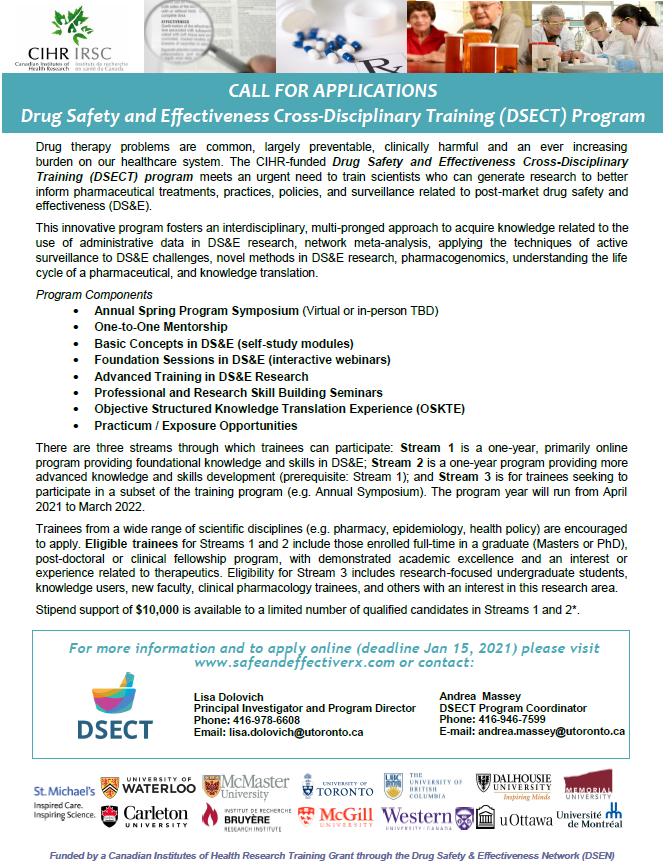
Open for Applications: CIHR Drug Safety and Effectiveness Cross-Disciplinary Training (DSECT) Program

This training program bridges clinical therapeutics, active surveillance, administrative datasets, research methods, health services and policy, pharmaceutical policy, meta-analysis, and knowledge translation to better understand choosing, using, and losing medications within the context of drug safety and effectiveness.

The program offers opportunities for trainees across a broad spectrum of research areas to learn together and from each other as a key impetus for filling the critical void of skilled, knowledgeable researchers in the area of therapeutics.

For more information, visit DSECT’S website .

Effectiveness of antibiotic prophylaxis effective at preventing iGAS in persons exposed to iGAS cases

What is the current situation?

Streptococcus pyogenes (group A streptococci, GAS) causes syndromes ranging from localized illness to invasive and severe disease. Invasive GAS (iGAS) infection causes significant morbidity and mortality, and the risk of contracting GAS infection is higher among close contacts of iGAS index cases. The Public Health Agency of Canada (PHAC) recommends the use of antibiotic prophylaxis among close contacts of iGAS, but a recent study did not find sufficient evidence to support this practice.

What was the aim of the study?

To determine if antibiotic prophylaxis is effective at preventing subsequent GAS infection in persons exposed to iGAS cases. To determine if the benefit outweighs the risk of unintended harm (adverse drug events).

How was the study conducted?

In MarketScan Commercial and Medicare databases (2010-2019) and the Quebec Pregnancy Cohort (QPC, 1998-2021), we studied the effectiveness of antibiotic prophylaxis in close contacts of confirmed or probable iGAS cases. MarketScan databases provide longitudinal data on inpatient/outpatient medical services, with identifiers that link family members on the same insurance plan. The QPC is a prospective cohort of all pregnancies of women covered by the Public Prescription Drug Insurance in Quebec. The QPC provides longitudinal information for mothers and their children on inpatient and outpatient medical services. In both databases, antibiotic treatment was considered prophylactic if initiated in close contacts within 7 days after the iGAS diagnosis in the index case, while subsequent cases were defined as the occurrence of GAS infection among close contacts within 30 days of the iGAS diagnosis of the index case. Unintended harms in those receiving prophylaxis included the occurrence of any adverse reaction to antibiotics within 30 days of the index case date.

What did the study find?

In QPC, we found 67 index cases of probable iGAS infection and 117 close contacts In close contacts, 29.9% (35/117) were exposed to antibiotic prophylaxis. No subsequent cases of GAS infection were identified among close contacts In the MarketScan database there were 17,078 index cases and 21,032 close contacts. 4.4% of close contacts were exposed to antibiotic prophylaxis o 25 subsequent cases of GAS infection were identified among close contacts o Secondary attack rates were 13.2 (95% CI 1.9-93.7) and 14.8 (95% CI 9.9-22.1) per 1,000 person-year in subjects exposed and unexposed to antibiotic prophylaxis In multivariate analyses, we observed a slight trend towards lower risk of GAS infection with antibiotic prophylaxis versus the unexposed group, though not statistically significant (OR 0.88; 95% CI 0.12-6.51; model adjusted for sex, age, comorbidity, steroid use, and recent past infection). The incidence of potential adverse drug events was 39.6/100 person-years (95% CI 27.7-56.6) among those receiving antibiotic prophylaxis and 10.6/100 person- years (95% CI 9.1-12.3) among those not receiving antibiotic prophylaxis.

In summary, our study was unable to demonstrate real-world effectiveness for antibiotic prophylaxis to prevent GAS infection in close contacts of iGAS cases. We did note a clear 3-fold increase in potential adverse drug events in the antibiotic prophylaxis.

For more information, contact: Autumn Neville, Research Coordinator. [email protected]

This research was funded by CIHR-DSEN 
Lead investigators: Dr. Sasha Bernatsky and Dr. Anick Berard
Query 20-07 raised by the Public Health Agency of Canada, Centre for Immunization and Respiratory Infectious Diseases

Safety and effectiveness of influenza vaccine during pregnancy

Low rates of influenza vaccination during pregnancy continue despite efficacy in preventing influenza infection in infants. Health care providers may be hesitant to suggest the vaccine to pregnant women due to safety concerns. Though it is generally believed that the benefits of protecting pregnant women and their newborns from influenza complications outweigh the small risks of vaccination, updated evidence is needed to support these recommendations.

This project aimed to determine if influenza vaccination during pregnancy is safe and effective for women and their newborn babies.  We studied women from the 3D Cohort Study (Design, Develop, Discover), comprising 2,366 women recruited during the first trimester of pregnancy (8–14 weeks) in Quebec.

Influenza vaccine during pregnancy was not clearly associated with all-cause hospitalizations in newborns, small birth weight, or being small for gestational age. Our estimates for spontaneous abortions were not conclusive due to relatively low precision. In sensitivity analyses related to the timing of vaccine exposure, we were unable to determine if risk differed according to trimester.

Our study confirms low influenza vaccine uptake in pregnancy, suggesting the need to promote influenza vaccine uptake in this group.

For more information, contact: Autumn Neville, Research Coordinator. [email protected]

This research was funded by CIHR-DSEN 
Lead investigators: Dr. Anick Berard and Dr. Sasha Bernatsky
Query 19-08 raised by the Public Health Agency of Canada, Infectious Disease Prevention and Control, Centre for Immunization and Respiratory Infectious Diseases

MEMBER'S UNIVERSITIES
© 2026 Copyrights CAN-AIM | All rights Reserved ~ login